CarX Street Best Tuning Settings for Fast Racing
Winning races in CarX Street is not only about having a powerful car. A well-tuned setup can make a much bigger difference when you need better acceleration, stronger cornering, and more control at high speed. Even a fast car can feel difficult to drive if its gearing, suspension, tires, or differential settings are not balanced.If you’re looking to get the most out of your car, start with our CarX Street guide before adjusting your racing setup.
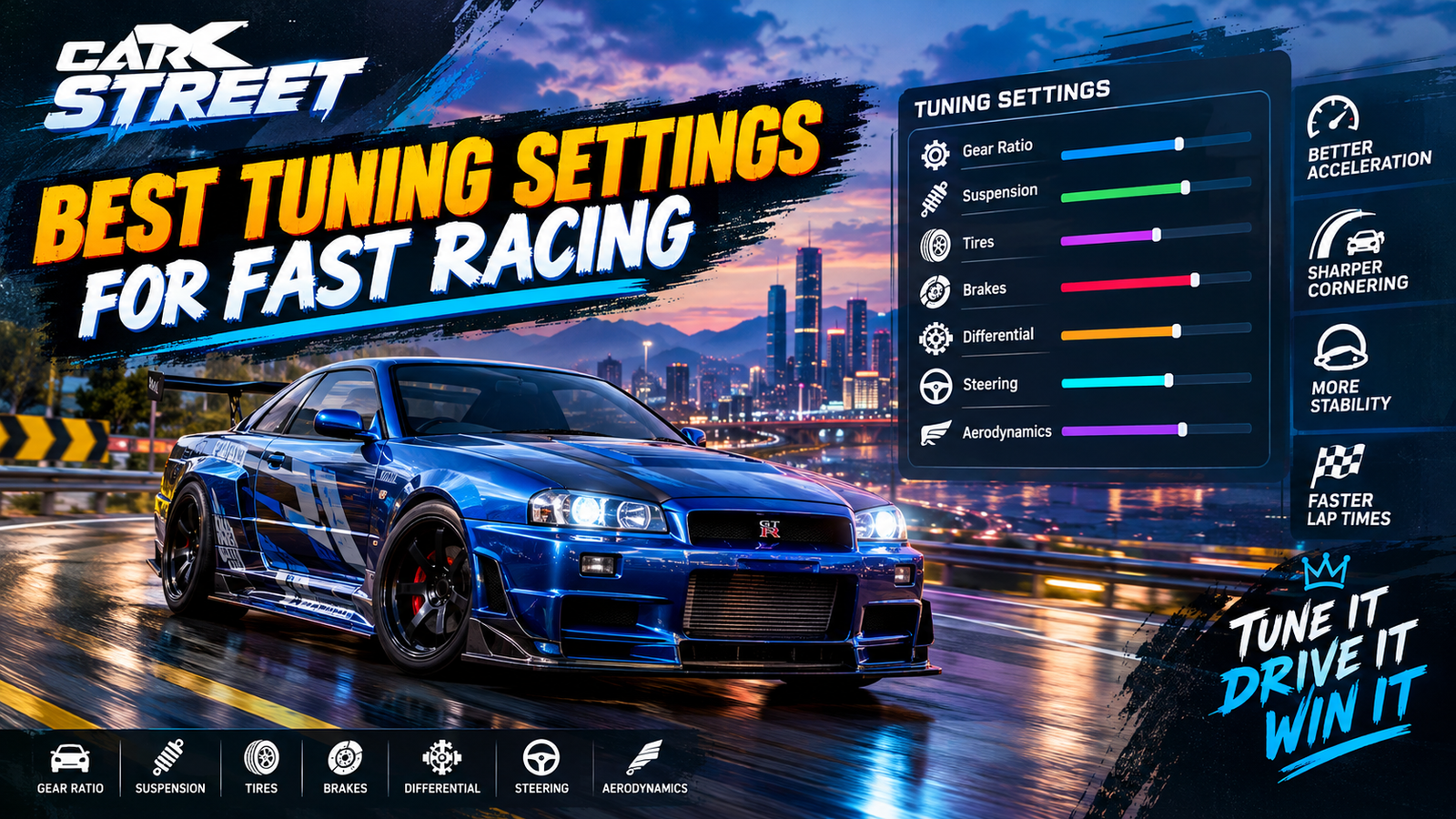
In this guide, we’ll look at some of the best tuning settings for fast racing in CarX Street and explain what each adjustment does. The goal is to create a setup that feels responsive without making the car unnecessarily difficult to control.
Why Tuning Matters in CarX Street
Every car behaves differently depending on its weight, drivetrain, engine power, and tire setup. Because of this, there is no single configuration that works perfectly for every vehicle.
A good racing setup should help you:
- Accelerate quickly after slow corners
- Maintain stability at high speed
- Brake with better control
- Reduce unnecessary wheelspin
- Take corners without losing too much speed
- Make the car easier to control during races
Instead of changing every setting at once, make small adjustments and test the car after each change.
Best Gear Ratio Settings for Faster Racing
Gear ratios have a major effect on acceleration and top speed. If the gearing is too long, the car may feel slow when leaving corners. If it is too short, you may reach the rev limiter too quickly.
For racing, start with a setup that gives you strong acceleration while still leaving enough room for higher speeds.If you prefer playing on a larger screen, you can also check our CarX Street for PC guide for installation details and a better keyboard-and-screen racing experience.
Final Drive
A slightly shorter final drive can improve acceleration, especially on tracks with frequent corners. However, making it too short can reduce your top speed.
For tracks with long straights, use a little more top-end gearing. For technical tracks, prioritize acceleration.
Individual Gears
Try to keep the gear changes smooth rather than creating huge gaps between gears. Your goal is to keep the engine in its useful power range after shifting.
If the car feels slow immediately after changing gears, the ratios may need to be adjusted closer together.
Suspension Settings for Racing
Suspension tuning affects how the car responds when braking, turning, and accelerating.
For fast racing, you generally want a setup that is stable without making the car feel completely rigid.
Suspension Stiffness
A firmer suspension can improve responsiveness and reduce excessive body movement. However, going too stiff may make the car harder to control over uneven surfaces.
Start with a moderately firm setup and increase stiffness gradually if the car feels too soft during cornering.
Ride Height
A lower ride height can help create a more stable feeling at speed and reduce unnecessary body movement.
However, avoid lowering the car excessively. If the suspension frequently bottoms out, the car can become unpredictable and lose grip.
Tire Settings for Better Grip
Tires are one of the most important parts of a racing setup because they directly affect how much grip the car has.
For competitive racing, focus on finding a balance between grip and responsiveness rather than simply choosing the most aggressive setup possible.
If the car struggles to maintain traction while accelerating, consider reducing unnecessary wheelspin before making major suspension changes.
Brake Balance for Better Corner Entry
Brake settings can make a noticeable difference when approaching corners at high speed.
A balanced setup should allow you to slow down quickly without making the rear of the car unstable.
If the rear becomes too loose under heavy braking, move the brake balance slightly toward the front. If the car feels difficult to rotate into corners, make small adjustments and test again.
Avoid making large changes because a setup that feels good at low speed can become difficult to control during emergency braking.
Differential Settings for Faster Corner Exits
The differential controls how power is distributed between the driven wheels.
A properly adjusted differential can help the car put power down when exiting corners. If the setting is too aggressive, however, the car may become difficult to control and can push or slide more than expected.
For fast racing, make gradual changes while paying attention to what happens when you accelerate out of a corner.
If the car loses traction immediately after applying throttle, reducing the aggressiveness of the setup may help.
Steering and Handling Adjustments
Fast racing requires quick but predictable steering responses.
If your car feels too slow when changing direction, increase responsiveness gradually. If it feels nervous or unstable at high speed, reduce the steering response slightly.
The ideal setting depends heavily on the car and your driving style. A setup that feels perfect for one vehicle may feel uncomfortable on another.
Aero Settings for High-Speed Stability
If your car has adjustable aerodynamic options, use them according to the track rather than simply maximizing one value.
More aerodynamic stability can make the car easier to control through fast corners, while a lower-drag setup can be useful on tracks where long straights are important.
For balanced racing, aim for enough stability to confidently carry speed through corners without sacrificing too much straight-line performance.
A Balanced Racing Setup to Start With
If you’re not sure where to begin, use a balanced setup as your baseline:
- Gearing: Slightly acceleration-focused
- Final drive: Moderate, adjusted according to the track
- Suspension: Medium to firm
- Ride height: Low but without excessive bottoming
- Tires: Prioritize consistent grip
- Brakes: Slightly front-biased for stability
- Differential: Moderate locking
- Steering: Responsive but predictable
- Aerodynamics: Balanced between cornering stability and top speed
These settings should be treated as a starting point rather than a universal formula.
How to Tune Your Car for Different Tracks
The fastest setup can change depending on the track.
Technical Tracks
Tracks with many tight corners benefit from stronger acceleration and predictable handling. Shorter gearing can help you get back on the throttle faster after slow turns.
High-Speed Tracks
On tracks dominated by long straights, excessive acceleration-focused gearing may limit your top speed. A longer setup can allow the car to stay in higher gears for longer.
Mixed Tracks
For circuits containing both long straights and technical sections, use a compromise setup. You want enough acceleration for corner exits without sacrificing too much maximum speed.
Test One Change at a Time
One of the easiest mistakes in CarX Street tuning is changing several settings simultaneously.
If you change the gearing, suspension, differential, brakes, and tires at the same time, it becomes difficult to know which adjustment actually improved the car.
Instead, change one area, drive a few laps, and compare the result. Keep the adjustment if it improves the car and reverse it if the handling becomes worse.Players using older devices can also explore our CarX Street older versions guide to find earlier builds that may work better on less powerful hardware.
Common Tuning Mistakes to Avoid
Even an expensive or highly upgraded car can perform poorly with an unsuitable setup.
Avoid these common mistakes:
- Making the suspension extremely stiff
- Lowering the ride height too much
- Using gearing that sacrifices too much acceleration
- Prioritizing top speed on technical tracks
- Making aggressive differential changes without testing
- Changing multiple settings at once
- Ignoring tire grip
- Copying another car’s setup without considering its drivetrain
The best setup is the one that matches both the car and the track.
Final Tips for Faster Racing
Before starting a serious race, spend a few minutes testing your setup. Pay attention to three moments: acceleration out of corners, braking before corners, and stability at high speed.
If the car feels slow on corner exits, work on gearing and traction. If it becomes unstable while braking, focus on brake balance. If it feels nervous through fast corners, look at suspension and aerodynamic balance.
Most importantly, don’t chase perfect numbers. A slightly slower setup that you can control consistently will often produce better race times than an aggressive setup that constantly causes mistakes.If you play on an iPhone or iPad, check our CarX Street for iOS guide for more information about the iOS version and installation.
Final Thoughts
The best CarX Street tuning settings for fast racing depend on the car, track, and driving style. Instead of relying on one universal setup, use a balanced configuration as your starting point and make small changes based on how the car behaves.
Once you understand how gearing, suspension, brakes, tires, differential, and aerodynamics affect the vehicle, tuning becomes much easier. With the right adjustments and some testing, you can build a setup that accelerates harder, carries more speed through corners, and feels much more predictable during races.