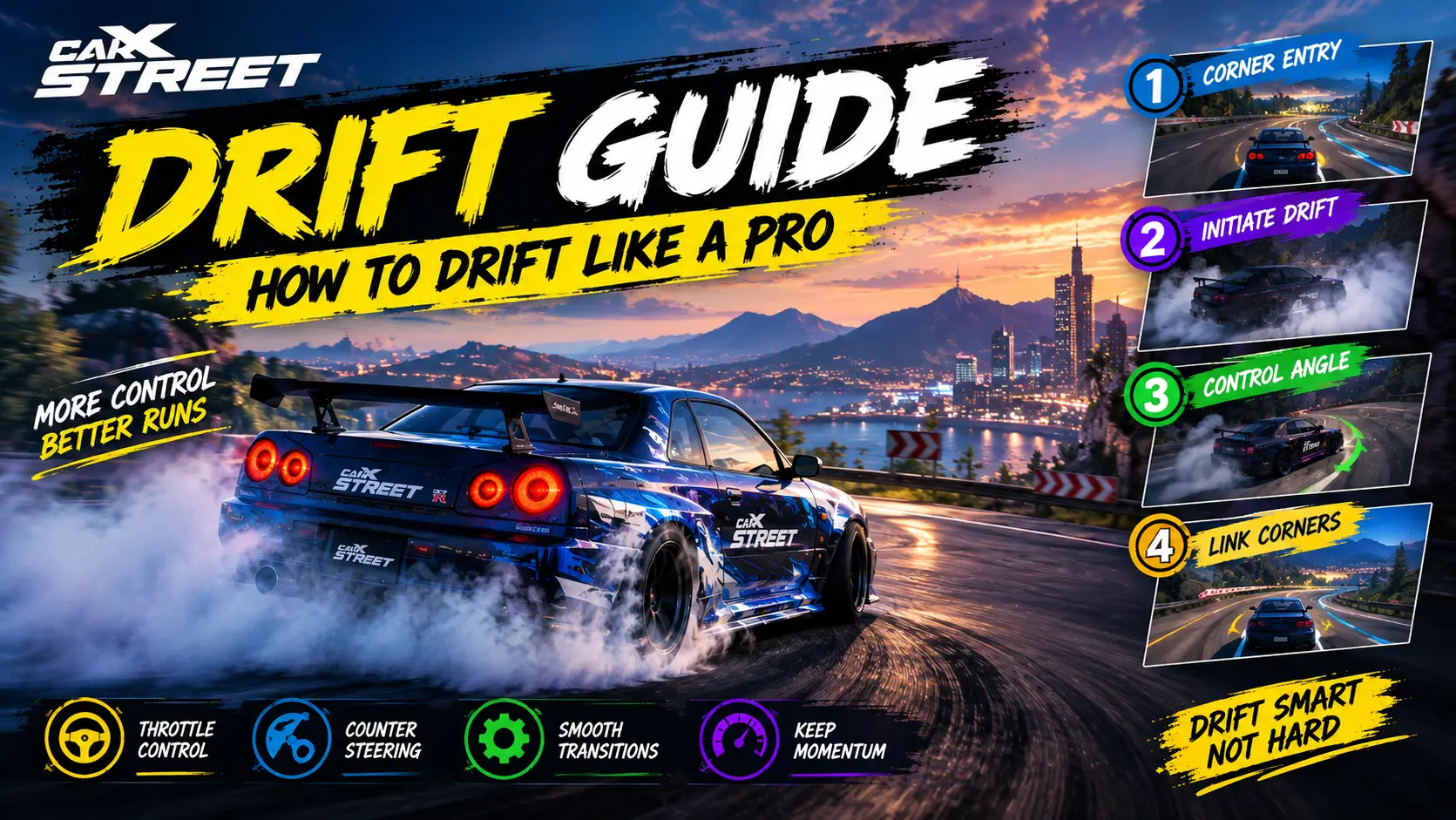
CarX Street Drift Guide: How to Drift Like a Pro
A clean drift in CarX Street is all about timing. You need to enter the corner with the right amount of speed, get the rear of the car moving, and then control the slide without losing too much momentum.Once these movements start working together, drifting becomes much more than simply holding the handbrake.
If you’re trying to improve your drift runs, this guide will walk you through a practical way to build control, from your first slide to linking multiple corners together.
Understand What Your Car Is Doing
Before worrying about huge drift angles, learn to recognize what happens when the car loses rear grip.
When you accelerate through a corner, the rear tires can begin to slide while the front tires continue pointing toward the direction you want to travel. This creates the sideways movement that makes a drift possible.
Your job is to keep that slide within a controllable range. Too little rotation and the car straightens out. Too much rotation and you end up facing the wrong way.
The best drifts happen when you are constantly making small corrections rather than one large steering movement.If you’re still getting familiar with the game’s driving mechanics, our CarX Street tips and tricks for beginners can help you build a stronger foundation before working on advanced drifting.
Build Your Drift Around the Corner
A good drift usually starts before the car reaches the middle of the corner.
Approach the turn at a speed you can actually manage. As you turn in, shift the car’s weight and use the throttle to encourage the rear end to step outward. Once the slide begins, your attention should move from starting the drift to maintaining the correct line.
Don’t chase the biggest possible angle. A smaller, stable slide is much easier to extend through the corner and usually gives you a better exit.
Master the Initial Slide
The first moment of a drift can determine how the entire corner develops.
Start by turning into the corner and giving the rear wheels enough power to lose some traction. If the car refuses to rotate, a brief handbrake tap can help initiate the slide.
The important part is what happens immediately afterward. Release the handbrake and get back to throttle control rather than leaving the car in a constant slide.
A successful initiation should put the car into a position where you can control the rest of the corner.
Use the Throttle to Control Your Angle
Think of the accelerator as your main drift-adjustment tool.
More throttle can increase rear-wheel spin and push the car into a wider angle. Reducing the throttle can settle the car and bring the rear end back toward the desired line.
Try not to make these changes suddenly. Smooth throttle adjustments allow you to react to the road without causing unnecessary spins.
During a long corner, you may find yourself repeatedly adding and reducing throttle. That isn’t a mistake—it is part of keeping the car balanced.
Counter-Steering Is About Timing
Counter-steering is not simply turning the wheel in the opposite direction and leaving it there.
As the rear of the car moves outward, steer against the direction of the slide. Then adjust your steering angle as the car’s position changes.
If you counter-steer too late, the car may rotate too far. If you do it too aggressively, the front wheels can pull the car out of the drift.
Use small movements and watch where the car is heading rather than focusing only on how sideways it looks.
Learn the Difference Between Angle and Speed
A dramatic drift angle can look impressive, but it isn’t always the fastest way through a corner.
If you rotate the car too far, you may lose speed and need extra throttle to recover. A moderate angle often lets you maintain momentum while still keeping the car sideways.
For faster runs, focus on carrying useful speed through the corner instead of trying to create the biggest possible slide.
This becomes especially important when two corners are connected closely together.If you prefer practicing with a larger display and keyboard controls, you can also check our CarX Street for PC guide to learn more about the PC setup.
Linking Two Corners Together
Once you can control one corner, start working on transitions.
As the first corner finishes, don’t immediately straighten the car and reset everything. Instead, prepare the steering and throttle for the next direction change.
A smooth transition should feel like one continuous movement. The car moves from one slide to the other while keeping enough momentum to enter the next corner.
Start practicing on two connected turns. When you can consistently link them, move on to longer sections with three or more corners.
Recovering From a Bad Drift
Even experienced players will occasionally enter a corner too fast or create too much angle. Knowing how to recover can save a run.
If the car begins rotating too aggressively, reduce the throttle and correct the steering rather than panicking with a large handbrake input.
If the car starts straightening before the corner is finished, gradually increase throttle and adjust the steering to bring the rear back into the slide.
The goal isn’t to make every mistake invisible. It’s to learn how to recover without completely losing control.
Pick Practice Corners Instead of Random Roads
Random driving can be fun, but focused practice will improve your technique faster.
Choose a corner with enough space around it and repeat the same turn several times. On each attempt, change only one thing:
- Enter slightly faster.
- Enter slightly slower.
- Use more throttle.
- Reduce the drift angle.
- Try a shorter handbrake input.
- Change your counter-steering timing.
This makes it easier to understand why one attempt worked better than another.
Tune the Car After You Understand Your Driving
Car setup matters, but changing everything before learning the basics can make improvement confusing.
First become comfortable with the car in its current configuration. Once you know what feels wrong, start making small adjustments.
For example, if the rear feels too difficult to control, you may need to experiment with the balance between grip and rotation. If the car struggles to maintain a slide, look at the areas of the setup that affect traction and power delivery.
Make one change at a time and test it over the same section of road.If you’re still getting familiar with the game’s driving mechanics, our CarX Street tips and tricks for beginners can help you build a stronger foundation before working on advanced drifting.
Use Different Techniques for Different Corners
Not every corner should be attacked in exactly the same way.
A wide, sweeping turn may require a controlled throttle-based drift that lasts several seconds. A tight corner may benefit from a stronger rotation at entry followed by careful throttle management.
Hairpins, fast bends, and linked corners all demand slightly different timing.
Learning to adapt your technique to the shape of the road is what eventually separates a player who can occasionally drift from someone who can consistently control a drift run.Your results can also depend on the vehicle you’re using, so check our guide to the best cars in CarX Street for racing and drifting if you want to compare different options.
Three Skills to Practice Every Day
If you want a simple routine, divide your practice into three stages.
Stage 1: Initiation
Practice getting the rear of the car to slide without spinning. Don’t worry about long drifts yet.
Stage 2: Maintenance
Once the car is sideways, concentrate on throttle and counter-steering. Try to hold a consistent line around one corner.
Stage 3: Transition
Finally, connect two corners without completely resetting the car between them.
Spend a few minutes on each stage rather than trying to master everything during one run.
Mistakes That Slow Down Your Progress
One of the biggest problems is changing too many things at once. If you alter your car setup, driving line, speed, steering, and throttle simultaneously, it becomes difficult to know what actually improved the result.
Another common mistake is chasing style instead of control. A huge slide may look spectacular, but if you cannot predict where the car will finish, it won’t help you build consistency.
Focus on repeatable drifts first. Style naturally comes later.
How to Know When Your Drifting Is Improving
You don’t need to judge your progress only by how sideways the car gets.
Look for signs such as:
- Fewer accidental spins
- More consistent corner exits
- Better speed retention
- Smoother transitions
- Less reliance on the handbrake
- More predictable throttle control
When you can repeat the same corner several times with similar results, you’re developing real control.If you want to compare the driving experience with previous releases, you can also check our CarX Street older versions page for earlier builds of the game.
Final Thoughts
Learning to drift like a pro in CarX Street is mainly about building consistency. Start by understanding how your car reacts, then work on initiation, throttle control, counter-steering, and transitions one skill at a time.
Don’t worry if your first attempts look messy. Every missed corner teaches you something about speed, timing, or car control. With focused practice, those corrections become automatic.
Once you can maintain a stable slide and connect corners without losing momentum, you’ll have the foundation needed to take your drifting to the next level.iPhone and iPad players can also visit our CarX Street for iOS guide for more information about playing on Apple devices.